
From Jail Arrest to Lee County Court Records
After an arrest in Lee County, the person is normally taken to the Lee County Detention Facility at 1401 Elm Street in Sanford for local booking. The public jail profile may show name, local identifiers, date of birth, age, race, sex, physical descriptors, address, housing location, admit date and time, bond, bond type, charging agency, arresting agency, court type, court date, docket number, and a mugshot when available. Those fields are useful, but they are still jail fields. They help identify the person and the booking charge that followed the arrest.
The formal court records after a jail arrest are maintained through the North Carolina Judicial Branch, eCourts, and the Lee County Clerk of Superior Court. Lee County is in Prosecutorial District 12, Superior Court District 12, and District Court District 12. The prosecutor may file, amend, reduce, dismiss, or supersede charges after the jail roster first lists a booking charge. Use the jail inmate records page for custody and roster details, and the jail mugshots page for booking-photo limits. Use court sources for the filed case and disposition.
The main county sources behind the custody side are the Lee County jail page, the Lee County Sheriff's Office page, and the Lee County public-record request form. The Sheriff's Office page names Sheriff Brian Estes and describes the office's law-enforcement, corrections, court-security, prisoner-transportation, and civil/criminal process duties.
Search eCourts for Court Records After an Arrest
The statewide eCourts Portal is the main online route for public case information. Smart Search can be searched by record number or by a name in Last, First Middle Suffix format. Advanced filters can narrow by location, party criteria, date of birth range, file date, case type, and case status when the fields are available. Select Lee County as the location when the case belongs in Lee County, but remember that a person arrested locally can have other cases in another North Carolina county.
The official North Carolina eCourts Portal page captured for this project shows Smart Search, Search Hearings, payment tools, and a CAPTCHA notice.
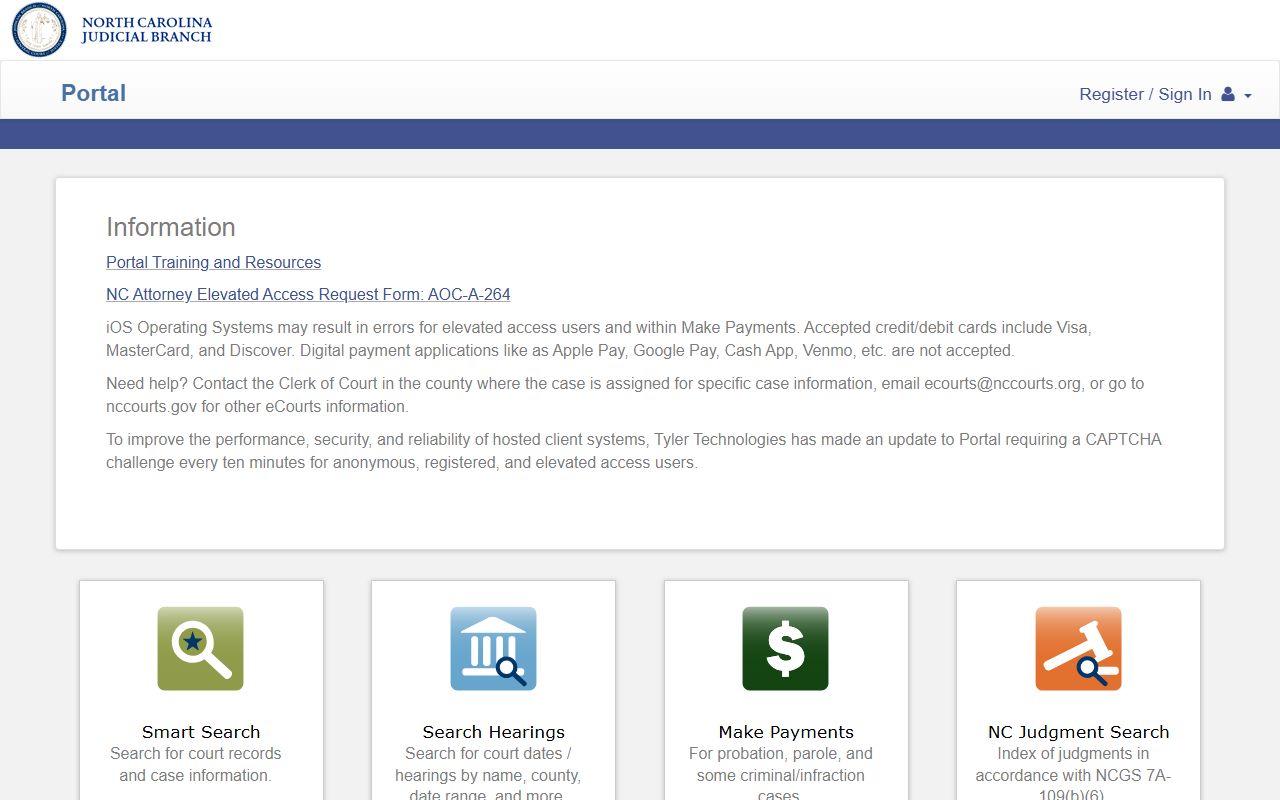
That portal is the better source for formal court status than the jail roster because it is tied to the court case rather than to the detention profile.
- Open the eCourts Portal and choose Smart Search for public case information.
- Search by docket or case number when the jail profile lists one, or use the defendant's name in the required format.
- Use the Lee County location filter if the search returns too many statewide results.
- Open the matching case and compare the filed charge, charge level, case status, next hearing, and disposition against the jail profile.
Portal access requires JavaScript and cookies. The research also notes a CAPTCHA challenge about every ten minutes for anonymous, registered, and elevated-access users. If a case cannot be found online, the Judicial Branch directs users to contact the Clerk of Court in the county where the case is assigned or use clerk terminals and paper files.
Search Hearings, Clerk Terminals, and Paper Court Files
Search Hearings is the eCourts path for court dates. It uses location, hearing type, search type, and party or person criteria. The available hearing types include criminal matters, and the search type can include case number, party name, business name, attorney name, attorney bar number, judicial officer, or courtroom. This matters because the Lee County jail page says court dates are updated only within 48 business hours after the detention facility receives them from the courts, and Superior Court dates may not be shown on the jail page because the inmate must appear before a Superior Court judge when called.
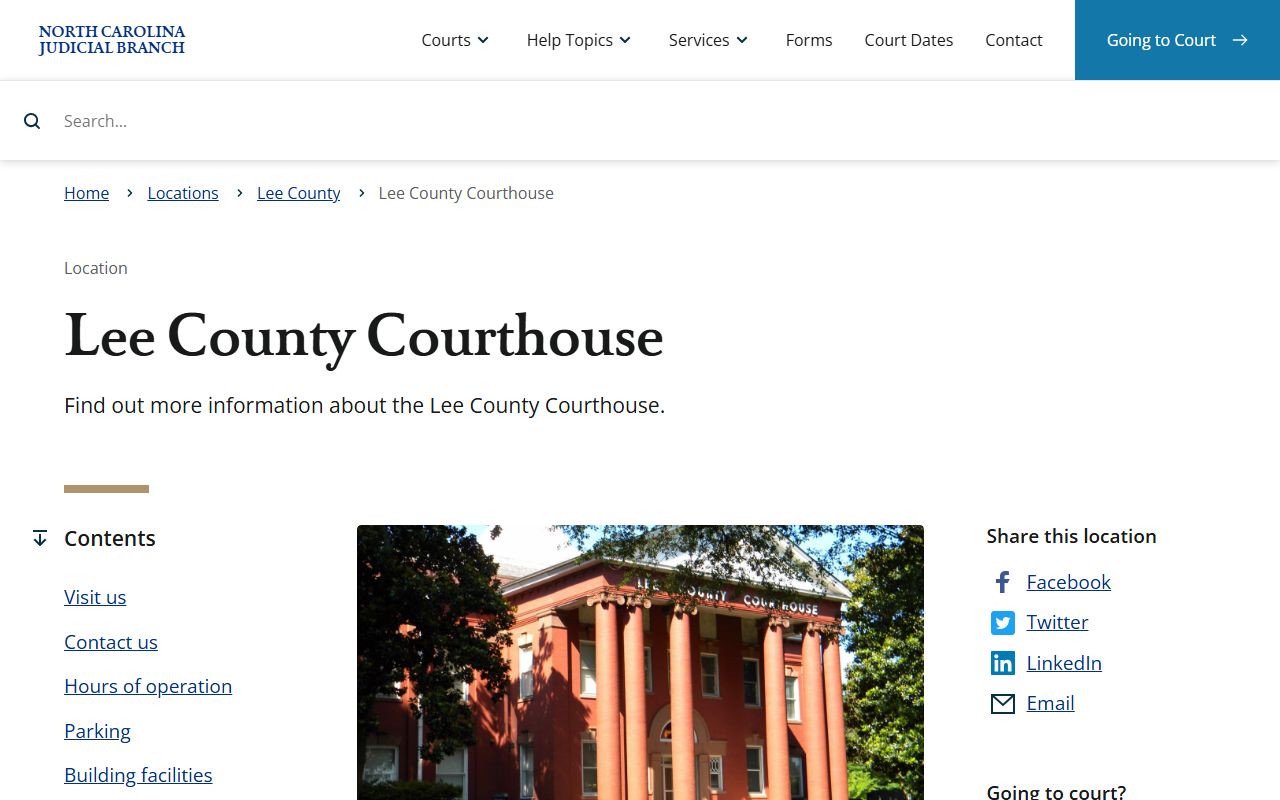
The Lee County Courthouse is listed by the Judicial Branch at 1400 S. Horner Blvd., Sanford, NC 27330, with mailing address PO Box 4209, Sanford, NC 27331, main phone 919-718-6300, and hours Monday through Friday, 8:00 a.m. to 5:00 p.m. Public parking is listed off Courtland Drive or Elm Street, and the courthouse page notes wheelchair access and vending machines.
The official Lee County Courthouse page is the local court-contact source for address, hours, parking, and access information.
When an online court records after an arrest search misses a case, the clerk's public terminals and paper files are the practical next step.
| Access path | Best use | Lee County note |
|---|---|---|
| eCourts Smart Search | Case number, defendant name, party filters, file-date filters | Use the Lee County location filter when the case is local. |
| Search Hearings | Upcoming court dates and hearing listings | Useful when the jail court-date field is blank or stale. |
| Clerk public terminals | Criminal case information by defendant, case number, victim, or witness | Available through clerk offices according to the Judicial Branch. |
| Paper court file | Older, unavailable, or copy-needed records | Request in the county where the case is located; copies may have fees. |
| Certified single-county background check | Name-based certified clerk search | Research lists a $25 fee for this clerk search. |
District Attorney Role in Lee County Court Records
Lee County shares Prosecutorial District 12 with Harnett County. The North Carolina Conference of District Attorneys lists Suzanne Matthews as District Attorney for Harnett and Lee County. The district office is listed at the Harnett County Courthouse, 301 W. Cornelius Harnett Blvd., Lillington, NC 27546, with phone 910-814-4500 and fax 910-814-4501. The Lee County courthouse contact listed for local court business is 1400 S. Horner Blvd., Sanford, NC 27330, 919-718-6300, and the Lee County contact directory lists the local District Attorney phone as 919-718-6310.
The DA prosecutes criminal cases for the State, represents the State in criminal and some juvenile matters, prepares the criminal trial docket, and advises law-enforcement officers. The DA page also explains an important routing distinction: misdemeanors, infractions, and juvenile matters are generally in District Court, while more serious felony matters generally move through Superior Court. The DA cannot ethically give legal advice to a person charged with an offense, so defense questions should go to a lawyer, not to the prosecution office.
Charging Documents After a Jail Arrest
North Carolina cases can begin from criminal process, a complaint, an information, an indictment, a warrant, an order for arrest, or related court process depending on the charge and stage. The jail roster may list the first booking charge, but the court file is where returned warrants, indictments, criminal summonses, and other formal papers become part of the case record unless sealed by court order under G.S. 132-1.4.
| Document or process | What it does | Where to verify it |
|---|---|---|
| Complaint or criminal process | Starts the allegation or process that can lead to arrest or summons. | eCourts, clerk terminals, or the paper court file. |
| Warrant or order for arrest | Commands an officer to take the named person into custody and bring the person before the court. | Returned warrants and orders may be court records unless sealed. |
| Information | A prosecutor-filed charging document used in some criminal matters. | Formal court case record, not the jail roster alone. |
| Indictment | A grand-jury accusation used for many felony matters. | Superior Court file and eCourts when available. |
Charge Status in Court Records After a Jail Arrest
A Lee County jail charge can differ from the formal court charge because the prosecutor and court may change the case after booking. The roster is still useful because it may provide the docket number, charging agency, arresting agency, court type, and court date. Those details help locate the case, but they should not be treated as the final charge history.
| Status | What it means in plain English | Why it matters |
|---|---|---|
| Pending | The charge or case has not reached final disposition. | Future hearings, bond conditions, and custody status can still change. |
| Amended | The charge was changed from the original wording or form. | The court record may no longer match the booking charge exactly. |
| Reduced | The charge was lowered to a lesser offense or class. | The final case may look less serious than the arrest-side listing. |
| Dismissed | The charge or case ended without conviction on that count. | A dismissal is not the same thing as an expunction. |
| Disposition | The formal outcome of the charge. | This is the court result to check before calling a charge a conviction. |
| Judgment | The court's final sentencing or order after adjudication. | Judgment details may affect custody, fines, probation, or transfer to NC DAC. |
Bond, Release, and Holds After an Arrest
Lee County jail profiles include Bond and Bond Type fields, and one inspected sample showed "No Bond." North Carolina pretrial release statutes include written promise to appear, custody release, unsecured bond, secured bond, and house arrest with electronic monitoring. The jail page lists release reasons that include inmate posts bond, court order, completion of sentence, payment of fine and court costs, faxed release of a hold from another agency, and transfer to another authorized agency.
Bond should be confirmed before anyone relies on a roster entry. The jail page lists Magistrates at 919-718-6319 and the jail at 919-718-4567. It also says release file review is time-consuming, is handled in the order received by the releasing officer, and detention staff are forbidden for security reasons from discussing when an inmate will be transported. Bond releases are listed as 7:00 to 11:30 a.m., 1:00 to 4:30 p.m., and 6:00 p.m. to 6:00 a.m.; sentence discharge releases generally occur 7:00 a.m. to 9:00 p.m. on the discharge date unless the court orders otherwise.
| Release or bond type | How it works |
|---|---|
| Written promise | The defendant promises to appear without paying money up front. |
| Custody release | Release to a designated person or organization, including some program representatives. |
| Unsecured bond | A bond amount exists, but money may be owed only if conditions are violated. |
| Secured bond | Backed by cash, property, or surety under court or magistrate instructions. |
| No bond or hold | No release bond is currently available, or another jurisdiction, agency, court order, probation, parole, federal, or immigration issue may block release. |
Warrants That Create Court Records After an Arrest
No official Lee County Sheriff active-warrant search, countywide warrant list, or Sheriff most-wanted page was located in the research. A jail roster search only helps after the person has already been booked. If a person is arrested on a warrant or order and processed at the Lee County Detention Facility, the profile may show charge, offense date, court type, court date, docket number, bond, charging agency, and arresting agency.
For unresolved warrant questions, the verified channels are Lee County Sheriff's Office at 919-718-4560, Crime Tip Line at 919-718-4577, Lee County Magistrates at 919-718-6319, Clerk of Superior Court at 919-718-6300, and the Lee County jail at 919-718-4567. Sanford Police P2C is an official city portal for events, arrests, crash reports, daily bulletin items, contact, and FAQ, but the accessible research did not confirm a warrant module.
Charges vs. Convictions in Lee County Court Records
An arrest charge is an accusation or process entry, not a conviction. A conviction generally requires a guilty plea, verdict, or other adjudication shown in the court record. This distinction is critical when reading court records after a jail arrest because a case may be pending, amended, dismissed, reduced, or resolved in a way that does not match the jail roster's original charge description.
| Charge | Conviction | |
|---|---|---|
| Meaning | An allegation or filed count in a criminal case. | A formal outcome after plea, verdict, or adjudication. |
| Timing | Can appear soon after arrest or prosecutor filing. | Appears only after the case reaches that result. |
| Where to check | Jail profile for booking charge, eCourts or clerk for formal charge. | Court disposition and judgment records. |
| Risk of confusion | May be amended, reduced, dismissed, or superseded. | Should not be assumed from a roster listing alone. |
Sealed and Expunged Court Records After an Arrest
North Carolina public-record rules do not make every criminal-justice record fully public. G.S. 132-1.4 treats criminal-investigation and criminal-intelligence records as nonpublic while requiring release of listed arrest and incident information unless another law blocks release. It also says returned arrest warrants, search warrants, indictments, criminal summonses, and nontestimonial identification orders are public court records unless sealed by court order.
Expunction is a separate process for qualifying records. The research notes that an expunction petition is generally filed in the county of charge or conviction, and Judicial Branch material lists a $175 fee unless an exception applies. A dismissal or acquittal does not automatically remove every public trace from online court, jail, commercial, or copied sources. The court file, jail record, and third-party copies can follow different rules.
| Sealed | Expunged | |
|---|---|---|
| Public visibility | Hidden or restricted by court order. | Removed, sealed, or destroyed as allowed by the expunction order. |
| How it happens | Usually by a specific court order or legal restriction. | Through a qualifying petition and court process. |
| What to verify | Whether the file, warrant, indictment, or hearing is restricted. | Whether the order covers the specific agency and record type. |
Background Check Limits for Court Records After an Arrest
Public court lookup and a legally compliant background check are not the same thing. The Clerk of Superior Court can provide a certified single-county name-based criminal record search for a listed fee, and public access terminals may allow non-certified courthouse searches without charge, with printing charges possible. For employment, housing, credit, insurance, or similar screening, use a legally compliant consumer-reporting process rather than a casual case lookup.
Important: This website is privately operated, is not government-affiliated, and is not a consumer reporting agency under the FCRA.